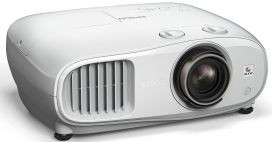
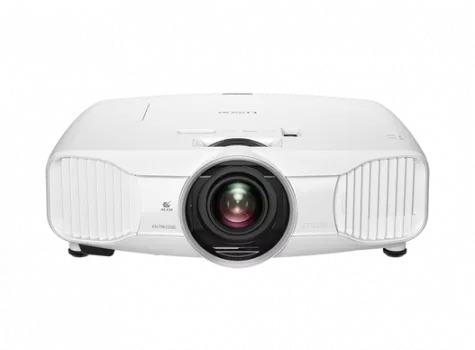
The equipment of the Epson EH TW7200 projector includes 2000 ANSI lumens, a contrast of 120000:1 with a HDTV 1920 x 1080 display. The manufacturer rates the durability of the included lamp at 4000 hours. A daily usage of 2 hours makes an operational lifespan of 5.5 years possible. For distortion-free image alignment, the projector offers both a lens shift function and keystone correction. The amount of leeway the lens provides can be checked in the Distance Calculator. A look at the light output reveals: The 2000 ANSI lumens are sufficient to illuminate an image width of up to 454 cm in darkened rooms. If room light is present, we recommend not exceeding a maximum width of 303 cm. Regarding signal processing, the model is compatible with incoming 1080P content as well as 3D. For convenient remote monitoring and administration, the projector is equipped with a classic RJ45 network socket. Since entering the market in 2013, production has been discontinued; the manufacturer no longer actively offers the model. However, it remains frequently searched within our database.
Display Type
3 x 0,74 LCD TFT Panel mit MLA HDTV 16/9 Liquid Crystal Display with Micro Lense Array
Real Full HD 3D Full HD 1080P compatible Lens shift Funktion Eco Mode Kensington Slot Gamma correction Remote control with backlight Lan network compatible.
So, I‘ve been using the 7200 (exclusively for film) since February 2015 and I‘m ready to share my opinion here. Let me start by saying that I‘m actually completely satisfied with the projector. Yes, there is a hidden limitation here, which I will discuss later.
Summary positive:
+ Lens shift range
+ Loudness
+ Color display (built-in color filter, active in cinema mode)
+ Lens (quality, very sharp display)
+ Automatic lens cover
Summary negative:
- Adjustment of the zoom / focus control a bit stiff
- Early dust problem
- Partially audible iris diaphragm (but you can usually hear it with the competitors and can also deactivate it)
Brief history: I had a Sanyo PLV-Z2 for about 11 years and was completely satisfied with it. Correct, there is no hidden limitation here and the reason for the new purchase was the technical progress from "HD-Ready" of my Sanyo to the "Full HD" generation plus higher brightness. 3D is just a nice side effect for me. A new lamp would also have been due soon ...etc.
For almost six months I had been looking at the current projector market. After a first demonstration at a dealer, I was convinced of the picture quality of current projectors and was also hooked. But they were all so huge...(LCD / LCOS) and I was spoiled by the small size of my Z2 (small, despite its strength in terms of loudness and lens shift range). I almost categorically rejected these projectiles and thought there had to be an alternative - I quickly came up with the idea of looking at the DLP faction due to the size. Also because I have a colleague whose DLP had left me with a lasting good picture impression.
The strengths of the DLP‘s are in my opinion:
+ the good in-picture contrast
+ the size
+ and the price
Now my own demands came into play...and over time this pushed the DLP competitors in question more and more into the background.
In my opinion, the weaknesses of DLP‘s are:
- the loudness
- lack of / insufficient lens shift range
- and often the low zoom range of the lens
With my favorites from this genre, I was already in the price range of around €1,200 and one of them was already comparable in size to an LCD
Due to the criteria that are important to me personally, such as (you‘ve probably already noticed) loudness and lens shift, the LCD / LCOS projectors came back with force despite their size. At that time, Epson had just launched the 6600, which was quite interesting in terms of size, loudness and lens shift. And in these categories it was also better than the DLP‘s. In the meantime, I also had contact with two dealers with whom I had lively discussions about the advantages and disadvantages of individual projector models. At times, a second-hand device was also an alternative for me (Sanyo Z4000). In short, I was stuck:
In order not to lose my overview, I created an Excel table with my priorities and a corresponding weighting. This worked surprisingly well and I realized that the gradation of my rating was analogous to the price for almost every model. In other words, the "best" models were also the most expensive. Mind you, I only included models up to a maximum of €3,000 in this analysis, with my personal limit being around €1,600. I was of the opinion that you have to pay less nowadays than you did in 2004 with my Z2. That was €1,750 for a modern projector. But fiddlesticks! The 6600 (rating 72%) was supposed to cost €1,699 when it was launched. That was clearly too much for me in a price-performance comparison. The models with a fairly good price/performance ratio in my opinion were the 7200 (rated 78%) and the Panasonic PT-AT6000E (rated 76%). However, the Panasonic was already quite an old (if not obsolete) model... A period of resignation followed and I suffered for a few weeks.
In the end, design was the deciding factor, as I "coincidentally" strolled past a row of projectors on display with my wife and she unerringly rated the 7200 as extremely stylish and you just have to live with the size... I then recovered, had two projector models shown to me again (7200 and Sony HW40 [rating 80%]) and decided on the cheaper 7200. Also because I liked its slightly warmer, softer picture (please don‘t confuse it with blurred!) and the larger lens shift range better. I did, however, do without the frame interpolation...but you have to die some kind of death. I‘m still very impressed with the image and color reproduction, which I hadn‘t expected at first. When I first set it up, I had both projectors running in parallel on the screen (half the picture covered on each, but visible as a whole) and couldn‘t believe that I was still enjoying the Z2‘s suddenly grotty picture so much. And the projector also continues to satisfy me in terms of my other criteria. The "actually" in my opening sentence refers to the premature appearance of an image error due to dust and an often audible iris diaphragm (if this is active). It is well known that the dust problem can occur sooner or later with an LCD, so I have accepted this problem with my eyes open. Also because of my consistently positive experience with the Z2. Since I bought it from the dealer, I currently have a replacement projector in operation, a 6600, because the 7200 was sent in for cleaning. So the circle is complete. At the moment, the market price for the 6600 is around €1,299 and you really get a lot of projector for your money, that‘s for sure! But I wouldn‘t want to swap, because the 7200 is superior in all aspects and not to forget: The better is the enemy of the good
A word of advice to all seekers: Take your time and compare at a demonstration if possible, be aware of what has priority for you and ask your wife in between...
For those who are interested, my favorite DLP models were:
Optoma HD50 (rating 68%)
ACER 9501BD (rating 68%) replaced by 9505BD at the time





 Real Full HD 3D







 Epson Website
 Product Sheet english