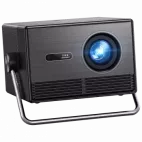
A projector from Planar is the PR5030, whose LED-BrilliantColor-DLP model delivers 3000 ANSI lumens, a resolution of WXGA 1280 x 800 and a contrast of 2000:1. The manufacturer specifies a runtime of 2000 hours for this projector's lamp. Looking at practical performance, up to 556 cm can be illuminated with 3000 ANSI lumens in dark environments. Once daylight is in the room, the image should ideally be no wider than 371 cm. Since entering the market in 2008, production has been discontinued; the manufacturer no longer actively offers the model.
Display Type
1 x DLP Chip WXGA 16/10 Ti Digital Light Processing Chip
Ansi-Lumen
Projector
3000
Screen
1200 Lux (200 cm Screen width)
Contrast
2000:1 full on/off
2000:1 full on/off
Black Level
1,5000 min. Lumen
0,601 min. Lumen
Offset
62% 15 cm over screen top edge →
SCREEN
+Projector
Resolution
WXGA 1280 x 800
1.049.088 Pixel UXGA 1600 x 1200 compressed
Standard-Portabel | External training and company presentations, as well as product presentations. Medium screen width or rooms with a little more ambient light, max. 200 lumens.
We have installed interactive whiteboards and Planar 5030 projectors in all classrooms at our school. After numerous comparisons, we opted for this
projector because it is incredibly quiet. It‘s a bit annoying at first because it dazzles more than the short-throw projectors we‘ve seen, but then I move the board up and out of the light cone. I can‘t get out of the noise level, and since we were using the board all day, that was the most important criteria for us. The Planar 5030 is so bright that we run it in ECO mode, and then you can‘t hear it at all - I don‘t need to adjust it, as it was already set on delivery, and it fits. The picture is great, which is probably due to the fact that you don‘t need a keystone adjustment.
Autor:
Informaticus 10.09.08
2
Stars
Moderately suitable for training rooms
Compared to Liesegang projectors used in the past, it is noticeable that the image is much smaller (the projector must therefore be hung much further away from the projection surface).
In addition, the operation is extremely annoying: If you want to get close to the image, you have to do this in 20 tiny little steps - coarser steps would be helpful. It is unpleasant that the projector remembers the zoom level even after it has been switched off: the next user has to laboriously zoom back to the original size, which unfortunately cannot be done at the touch of a button.



 Freeze


 Planar Website
 Product Sheet english HC